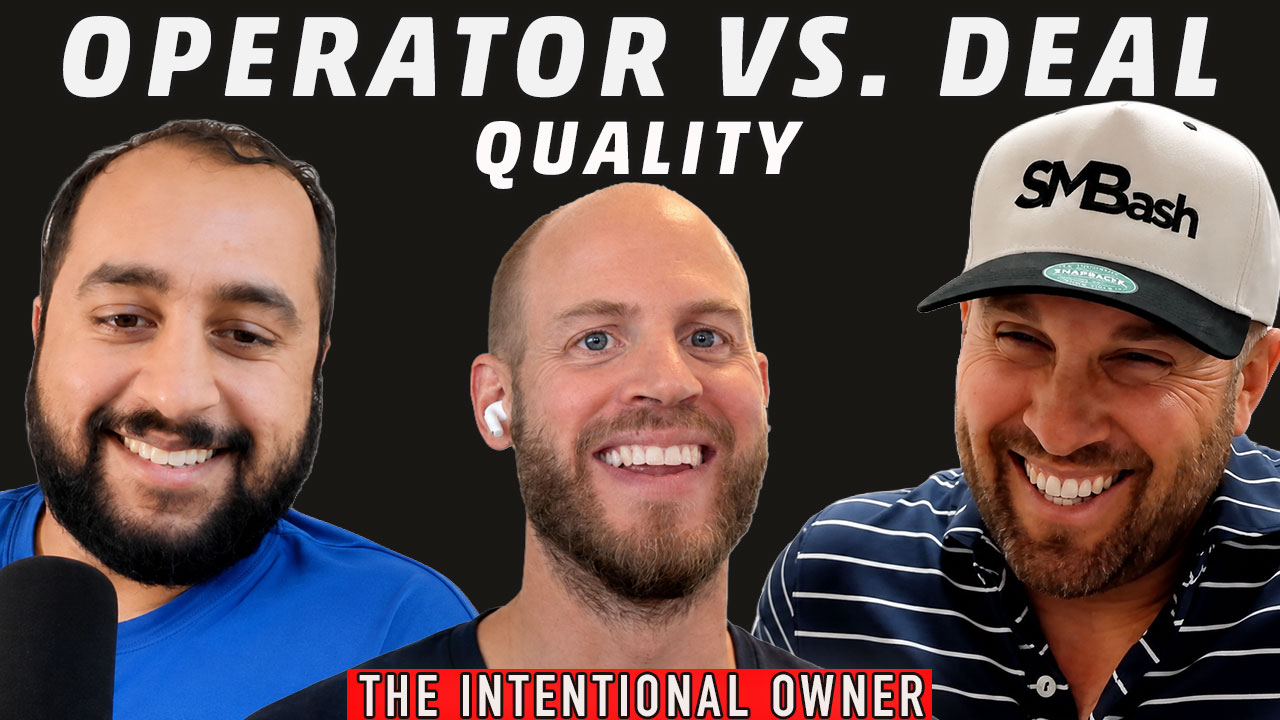
Does the deal matter less than the operator?
Why Operator Skills Matter More Than Deal Quality in Small Business Acquisition
Almost every time, yes. Small businesses are owner-dependent, so what you do in the three to five years after closing moves the outcome far more than the structure you signed. Adam Markley has watched this from all three seats, searcher, operator, and now investor.
One wrinkle: structure still matters enough that Adam's own regret is having bought too small and raised too little, not having been a worse operator.
If you have 7 minutes
Chapters
03:22 Adam Markley's ETA journey
07:09 UK acquisition dynamics and tax arbitrage
09:28 Lessons from buying and operating businesses
10:32 Operator fit versus deal quality
13:19 Why operators matter more in small business
14:35 Economic alignment in self-funded search
20:34 Investor case studies from 2024
31:35 Assessing operator quality and playbook depth
35:20 Post-close expectations and communication
41:16 Sales skills as a red flag indicator
45:21 Rapid fire: advice and resources
47:19 What Adam would do differently
From the conversation
A great operator can be very successful with a mediocre deal. A mediocre operator will likely be unsuccessful even with a great deal.
How they communicate to us as investors is a microcosm for how they're going to present to customers.
I would have gone bigger, both in terms of scale of the business I first bought, and I would have gone infinitely deeper on capitalization.
About the guest
The hosts

Sam Rosati
Owns and operates through Perimeter Solutions Group and founded SMBootcamp.

Kaustubh Deo
Owns Blooma, a tree care business in the Pacific Northwest.
Both are operators first.
Learn the operator side before you buy
LIVE—Denver, Oct 21-23. Three days on the full acquisition process from search to close, co-hosted by Adam Markley of PROX Capital Group. Applications close October 10. We cap attendance.
Apply to LIVE—DenverMentioned in this episode
- Grit It Done by Reid Tileston
- PROX Capital Group
Transcript
Sam: Everybody wants to be a business owner. Ain't nobody wanna sell. Very rarely do people have the cojones to get in the sales seat, talk to customers, and figure it out. How a searcher, I'll call it communicates, but really sells people like us who are investing, I didn't catch that as a red flag enough. I assumed somebody could present a deal to me, kinda do it poorly, and then go operate better than that. Not true.
Adam: A great operator can be very successful with a mediocre deal. A mediocre operator will likely be unsuccessful even with a great deal.
Kaustubh: All right. Welcome back to The Intentional Owner. You've got me, Kaustubh Deo, as always, with my co-host, Sam Rosati, and a special guest that, Sam, you can intro.
Sam: Yes, so today, in case you're not watching on the screen, which you should, our friend Adam Markley from Denver. Adam, welcome.
Adam: What's up? Glad to be here, guys. Always, always fun.
Sam: Well, unlike the usual reasons for guest speakers, which is to, like, level out Kaustubh and my terrible hairline, you're gonna make it just as bad, but really, really why you're here is because you have sort of gone through most of the ETA life cycle from, let's call it, like, a want-to-be searcher, a searcher, an acquired owner/operator, and then to sort of like a typical transition. Which is, like, once either you've sold or have things on the steady, you've sort of become an investor, and now you do that professionally. So not only have you seen, like, the whole... experienced the whole spectrum, but you've seen a lot, and I think a lot of the people listening would love to take advantage of that pattern recognition, hear about your reps and your experiences.
Adam: Yeah. It's been quite the... we'll just call it a decade at this point of finding a doorjamb, kicking it, hurting my foot and then kicking it again just to make sure that was the reason it hurt.
Sam: Would you mind, like, backing up a little bit and give us like a 30, 45-second intro to your ETA career.
Adam: So I got into it accidentally. 18, 19 years old, I always wanted to buy companies, which feels like a weird thing to do when you're 18 or 19. Wanting to buy small companies too, not the kinda corporate M&A route. Hated college, stumbled into accounting and finance, enjoyed that. Graduated early after nearly failing out trying to be an engineer, and led an exceptionally mediocre corporate career. Hindsight being 20/20, it was a great platform for where I am now, but it was frustratingly challenging from a lateral move perspective. I did public accounting, worked on a ton of small businesses. That really set the love affair deeply into my body. Fast-forward later into my professional career, I'm working for one of the largest direct response publishing businesses in the country, in the world. So this is marketing on steroids. This is millions of paid customers where see ad, see promotion, buy digital products predominantly. Data at a level that people in the small business space could never understand and really can't fathom. Imagine being able to track your lifetime value on a customer down to the individual ad creative they clicked on.
Sam: Oof. I wish.
Adam: Right? Can you imagine what your average SMB could do when you've seen that?
Sam: To be clear. It'll never happen. We don't have to think about it.
Adam: Yeah. But the idea is, like, being able to see that kinda data and being able to understand how those levers really get pulled to maximize... We had our happy email button. We'd send an email and make 100 grand. You know, there was just... It was a different scale of the exact same problem that every business is solving, done at the tenth of 1% level. Ultimately, what got me into true back of BizAc here is I tried starting a couple little companies, think residential clean at some point, think some of the kinda classics. And then ultimately, through the deals I was doing, I ended up acquiring an education company teaching people how to buy companies. So long before Cody Sanchez and long before kinda the proliferation of things like Acquisition Lab and Acquira and, gosh, dozens and dozens that have come over the last ten years. Was one of the early folks in the space, so I acquired that. The deal I negotiated was an all earn-out deal, which was great. The billion-dollar legal team for the company screwed that great deal up, which really sucked, but ultimately concurrent to not only doing that deal, outside of that started looking at doing acquisitions and a year after acquiring that education company in, I actually left, reacquired the education company out of the big business. Another great deal. They wrote us a check on the way out, and it was an all earn-out payback and kinda left. At this point, I'd already started kinda what's now my holdco. We were starting to look at deals, starting to invest and acquire, and then I left the education company within twelve months. So in my acquisition path, I've acquired companies in the UK and in the US, so I know what transactions outside the US look like for small businesses. It's radically different. You wanna talk about the ultimate use other people's money. There was a tax regime in the UK that meant your closing payment would mostly be just their cash out of their company 'cause they would save. It would go from, like, a thirty-three percent tax rate to ten for the first ten million dollars of an exit. So you have this business doing like three, four million of revenue, making, I don't know, six hundred grand, five hundred grand pre-tax a year. So net of tax is four hundred K. They have three million of cash on the books.
Kaustubh: Wait, what?
Adam: Yeah, it's crazy. And so your closing payment would be, I'm gonna buy... Say that's doing six hundred K of as we think of earnings here. You buy it for two million bucks, but you're actually paying them five million, and the first three is just their own money, the cash on the balance sheet 'cause it's then incorporated into the transaction.
Kaustubh: Right.
Adam: So the very first deal I did over there, a hundred percent of the closing payment was his own money. Weird, 'cause he saved that much in tax. You know, if you had three million in cash, that savings for you, twenty-three percent of three million is massive. I mean, six hundred and sixty grand.
Kaustubh: Like, basically what you're saying, it was taxed differently if taken as a gain as opposed to as a dividend.
Adam: Correct. Yeah. And so it just sets up things, financings different. But anyways, to what's relevant was acquiring, started acquiring here in the US. Through that process, I've acquired using the SBA four times. I've done non-SBA transactions. I bought some cool businesses. I've seen basically all the pros and cons to the acquisition game. I know what seller fraud looks like. I know what having a sue seller looks like as a result. I know what key person risk looks like, and I know what it doesn't look like when you think you have it, and, you know, bought a company, had a president, non-owner president in it. We had to term him seven weeks in, right? Turns out he was doing two hours of work a week and was kind of presenting both sides to everyone else. And so through this process, again, on-market, off-market deals, if you had a matrix of, like, what the classic acquisition narrative is, I've checked basically every box just with my own acquisitions, absorbed a lot of brain damage. If I could go back, I would not do it the same way again. And so my advice is tailored predominantly in twofold. One is just the lessons I've learned along the way and how do you maximize your likelihood of success. And then two is transactionally, all you're doing is starting the journey. What happens after you buy is where the real value is created, and this ecosystem prioritizes the transaction because that's where the widest part of the funnel is, so to speak. And so when we're investing at this point, right, we've raised a fund to write pretty meaningful checks into self-funded deals and sponsoring deals. At the end of the day, like, we're investing with a mindset of, like, what is it truly going to take to be successful in the next three to five years because nothing's going to matter. It doesn't matter if you close what's a great deal if you can't actually execute on that vision.
Sam: Well, let me try to distill it because I think Kaustubh and I love to get into the details a little bit. We'll stay confidential. But it sounds like over almost a decade run, you bought for your own account and with the SBA and for your employer. You bought a bunch of businesses, you ran a bunch of businesses. But one of the points that overarches, like, what you do at PROX and your investor perspective is how to be successful as an operator comes both from a good deal, good structure, good price. But in large part, it comes from a good fit between the buyer who's gonna run it and the industry the business is in. Is that the right takeaway?
Adam: That's a great takeaway, and I think it's a little surface level still to say, like, buyer fit to some degree, right? And that's what we all talk about all the time. But it's being uniquely positioned to bring some kind of value to the equation. And whatever that positioning is, is unique to all of us individually, what we're capable of doing. And this isn't the right path for everyone, I'd not recommend it for most people, but it's being very intentional. Deal structure is great, it can mitigate tons of risk and can capitalize things properly when planned and thought about intentionally. But ultimately, at the end of the day, if I had to sum it up in a single kind of cliched phrase to some degree is I'd say, "A great operator can be very successful with a mediocre deal. A mediocre operator will likely be unsuccessful even with a great deal."
Sam: That's a good point. What's funny is I know that, I think it's Warren Buffett who says something like, essentially what Warren Buffett is saying is, "The operator does not matter nearly as much as the industry the business is in, and sort of the durability of the cash flows to that business, and the sort of reputational goodwill of the business." What's funny is I actually agree with you that in small business land, those things can largely be reversed.
Adam: Ooh, correct.
Sam: Yeah. And an operator can overcome mediocre economics, mediocre industry trends. And why is that? Like, what's y'all's take on that point?
Adam: Well, let's take a classic example of the two extremes, right? Let's talk large private equity. We understand their model, and let's dive into that. Who makes the most money in large private equity? It's the GPs of the fund relative to the investment they're putting in. Right? So they're sourcing, structuring, and facilitating the deal, adding some financial engineering and hopefully some operational excellence that allows the business to grow. The actual operating partners and executives of the operating company they put in make the tiniest fraction relative to the actual main GPs, the MPs, MDs of the PE shop. You know, for a very successful PE shop, it's not uncommon for your lead MP, MD to walk away with a billion worth of gains, right, over the course of a ten, fifteen, twenty-year successful career. Every operator, if you tallied every operator of the portfolio companies that they were successful with, would still be a small fraction of what that individual collected, right? This is tried and true. It's why PE's a pretty top-heavy element in terms of compensation. Nothing wrong with it, it's just the model. Flip to self-funded search, the kind of other end of that. If you raise capital in self-funded search, if you give me as an investor a five X return on my money, I'm pretty happy. Like, I'm very happy in a reasonable timeframe, right? If it's twenty years, maybe not. But in that seven-year timeframe, five X, I'm pretty happy. If I got five X, it means you individually, for the cash you put in, you probably got a thirty, forty, or fifty X of the money you put in, right? And so the operator is just fundamentally structurally rewarded in such a substantially different way, right? And then if we start blending a little and we go, we'll use independent sponsor as kind of the next element for traditional search. Traditional search, they're gonna walk away with twenty-five percent-ish of economics if they hit hurdles and exit and last the five years and do all that, right? That's still very significant economics relative to the role, certainly relative to the individual operator working at a PE owned company doing fifteen million of EBITDA a year. That person's gonna have a cash comp of a half million a year, maybe seven hundred K, including bonus, and they're gonna have options of call it a million a year based on vesting.
Sam: So you're seeing the economic alignment of a self-funded search deal is what's driving those outcomes?
Adam: I don't know if it's driving it. I think it's reflective of the significance of the operator's impacts on the outcome. 'Cause let's just be clear, on a fifteen million EBITDA business, assume twenty percent margins for that, you're doing seventy-five million a year of revenue. Pulling a 500k CEO out and putting another one in, not saying that's easy. None of this is easy. But on the relative significance, your ability to pull that executive out and put another executive in there is substantially easier relative to, hey, that company making a million a year of earnings. Everything is reliant on that person, right? We'll use Kaustubh. Kaustubh, the first twelve months after you bought your company, could we just terminate you and then things be successful? How fast would we have to have someone in there? Would momentum die the moment you left?
Sam: Of course it would, right? First twelve months, you couldn't fire a seller.
Kaustubh: I mean, basically, like the way I think about it, right, is like small businesses are just worse businesses. Right? And they are so much more owner-dependent. They're not nearly as sturdy as larger businesses. So like, yes, the owner or the operator is so much more crucial to returns outcomes, which is like why they're cheaper also, right? I think that's like a bug, not a feature, but it is true.
Adam: But in the space of people trying to leave corporate and the people who have operational excellence and ability to be talented operators in their own right, this is where the inherent arbitrage opportunity for wealth creation comes in, is because the structure and the models on the lower end of the market are infinitely more rewarding for a great operator than the higher level roles.
Kaustubh: Well, with the caveat obviously that like 100% agreed on like relative to the capital, right? It's like relative. But the pies are much smaller, right? So even if you're getting a much larger relative benefit versus capital, which is the way I think you're right. Like it reflects that the labor is much more important of the operator in a small deal. Like every one of our executives in the PE businesses I was invested in, like they made way more money than any self-funded searcher.
Adam: They certainly did on an annual basis.
Kaustubh: On a long-term basis too.
Adam: Yeah. I think it depends on the outcomes, right? I mean, how many of those... You know, when you get out of PE, you weren't living the land of massive continuation vehicles that we are today. It was a different ecosystem. It certainly is in the last four years than it has been previously.
Kaustubh: I'm not knocking. I will say also, I have the caveat that, like, to me, 15 million EBITDA, that's, like, the lowest of middle market PE, right? Whereas, like, the smallest deals we looked at were, like, 50 plus of EBITDA and, like, the largest deal I worked on was, like, 950 million of EBITDA. So it's just like it's a different, like...
Adam: I think it's different. Yeah. And I'm mostly comparing lower middle market and middle market PE simply because the volume. There's still not a ton of billion-dollar earnings companies out there just yet. But all that said, from a career path trajectory, if the goal is to be an executive in some capacity and you're playing your odds and level of control and influence, down market is where you're gonna find the largest volume. But I think what we're ultimately targeting at isn't what your likelihood of financial outcome is because they can all be successful if you're good at what you do. I think that's fundamental for any professional path. If you're in the top 1% of any field, you're gonna be just fine. The realization and, I think, the harsh reality that a lot of people who wanna come down this path have to recognize is that almost all of us aren't top one percenters in anything that we do. I'm certainly not gonna beat Usain Bolt in a footrace. So finding the things that I am good enough or solid enough at that maybe I'm not 1%, but maybe I'm top quartile, top 25%, those things are just gonna increase and be compounders in my likelihood of success. Hey, you've never managed people before? Great. Don't buy a business yet until you know how to manage people.
Sam: Guilty.
Adam: Not because you can't be successful, but man, it's gonna make that path a lot easier. It's a shortening learning curves.
Sam: Do you think we could dive in a little bit? 'Cause I think the pattern recognition that you've got over time is gonna be helpful. Something like, are you willing to share... 'Cause I think there's this big tension between, all right, you're trying to assess an operator's skill, match it to a business where that skill really matters in driving outcomes, and maybe compare that to, like, just good old-fashioned revenue quality. Would you mind going through, like, the businesses you invested in last year, obviously staying confidential, and talk about, like, maybe backgrounds of the operators and the businesses they bought?
Kaustubh: Maybe, like, pick two or three, right? And, like, how do you think about the buyer background to deal fit?
Adam: Yeah, absolutely. All right, so the most recent one is a large franchise home care biz, twenty million of revenue. So a good-sized business. A hundred and seventy total employees. I mean, it's a people and process-intensive biz. Very atypical self-funded searcher who bought that for two reasons. One, reasonably well-capitalized himself, was not a 30 to 40-year-old, talking mid-50s, and through his professional experience, had built and managed and developed an absolute ton of people, and it was really evident and reflective in his quality of communication. People who have managed people understand the importance of clear communication, regularly setting expectations, managing accountability up and down. The entire deal process, I was, by far and away, the best searcher I've ever interacted with from a communication standpoint, and I've been around thousands. I mean, the update communications, the thoughtfulness around non-email, so verbal calls and approaches to difficult situations, just very not reactionary, and it showed some of that experience of just dealing with people 'cause that's hard. When you haven't dealt with people, you just wanna... And even it's a personality flaw, but you just wanna react to what's in front of you. So getting into a business that is so people-dependent, both on the client side, home care has hundreds and thousands of clients, and on the provider side, which is still hundreds in his case, the ability to navigate that so efficiently and with a set of clarity is the ultimate difference-maker for him.
Sam: What we heard was home health care franchise big. So, like, the unit economics are what? Lots of transactions with individual people in their homes, lots of care providers. So good, like decent revenue quality.
Adam: Yeah, revenue quality is good. Your biggest risk on revenue is that a lot of them are gonna be dependent on government stroke of pen risk. So you've got funding from Medicare, things like that. So that's probably the biggest hit to potential revenue quality. But overall, these businesses are human capital dependent, and your ability to sell trust and credibility and things like that internally and externally. And he had this in spades.
Kaustubh: Well, actually, I'm curious, Adam, like the guy you're describing who's gone into this business, I mean, every business is people-dependent to some extent. Obviously, this one is more than others, right? But it sounds like this is a searcher that, given the background and career spot, would be pretty successful in a lot of deals. So I'm kinda curious, like, okay, if you were to take this specific person who's probably more experienced than ninety percent of ETAers generally, and definitely more experienced than me by a long shot, right? Like, what is a deal that that person maybe would be a bad fit for, like a hypothetical deal?
Adam: Yeah, absolutely. I'm not dropping him into a manufacturing business, right? His background was a little bit more classically white collar, worked for at least one of the FAANG businesses and managing teams there. And so I'm not necessarily dropping him into a manufacturing business. Probably not a tree business. I'll save that for my PE bro over there. So I wouldn't necessarily translate him directly to straight classic blue collar. So people intensive on white or light white collar is gonna be a much better fit. It's just different kinds of communication, different kinds of motivations and expectations and things like that. So that would be businesses that wouldn't be a great fit. You know, an asset-heavy logistics business would just wouldn't be, I'd recommend. That said, that would be the second one I'll bring up. Is an asset-heavy logistics business. So we invested in a refrigerated trucking business earlier this year. Talking about revenue and quality, business has grown consistently every year for basically decade plus, just consistently adding, adding, adding. And if you're familiar with the trucking space, the trucking space by and large has had some ups and downs the last few years. It's kind of rounding into a bit more normal, have been pretty rough. We've seen some major players just fall apart and die. And so there's a delta between the macro narrative of the national versus what's happening either regionally or operationally with a particular business. Revenue quality is intense. For as fast as they would wanna add trucks, they can add volume. They've got great footholds in great growing markets and just have the ability to execute on that well. They've got a nice little terminal to terminal set of runs, so it's a very clean operational setup. Here's what's unique. There's a little bit more operator-focused independent sponsor. So this is in your classic buy one to disappear twelve months later, buy a completely different company. He's in the business every day. He's not necessarily taking the prior owner's spot, but he's in there solving problems. For example, his number one solve financially to date in the last five months since buying the company is renegotiating their insurance, saved almost six hundred thousand dollars a year. Which I'm not very good at math, but in any kind of multiple equation of that, that falls straight to bottom line. That is a lot of cash flow to incrementally add value to. And so things that were particularly interesting, we actually said no to this deal a year ago when it first came across our desk. Another deal we had done, that operator referred us, someone he had known, and we said no. At the time, it didn't make sense. The deal subsequently changed a good bit, fell apart as all deals do once or twice. One of the fallouts, the bank refused to wire the money the day before closing because one of the executives of the bank all of a sudden got cold feet, more on a personal basis. Not with people tied, but personally ended up not liking the space or something. It's kind of a weird scenario. Anyways, deal ended up closing, and what we liked about this guy from a match that fit perspective, didn't have a logistics background. Actually, Kaustubh, not too dissimilar from you, a little bit more of a PE investment banking kind of professional background, but jumped into the weeds from the beginning. So his due diligence was pretty impeccable in terms of, like, how he was diving in. But while he was due diligencing the company, leveraging AI, he was building a CRM and operating model to match the industry and match the actual cadence of the business. Now, he worked on the deal for a year plus, so there was a lot of time to get into that, and they are now very close to actually rolling out that model, the now more finalized iteration of it. One of the terminals is already using it partially, and it's ultimately gonna go for mine. So there's like getting yourself involved operationally from a due diligence perspective to, like, broadly understand a business. Hey, so you sell a client a service or a product, and then what happens? There's a different level of understanding when you are trying to build an actual operating framework for the business while due diligence-ing it. It forces you to think about every element of the business from an idea to cash in the bank and everything in between at such a different level.
Kaustubh: That makes a great fit. And it shows you that the searcher is, like, really a high agency, like, wants to understand this business.
Adam: Oh my goodness. I mean, first of all, ignore all the classic can you bounce back from the normal hits that happen during the closing process, right? Resilience is an often used word that comes about, but it's in the face of that executing aggressively in your own way, your own time. He lives relatively close to one of the terminals, but over fifty percent of the time he is commuting to the other, that's four hours from his house for the entire week, right? This is commitment. This is showing up and being there. He has a phenomenal relationship with the sellers. They've retained equity, are on the board, are still in the business. It seems like every other week they have, like, a four-hour dinner, and they're catching up and they're working on things. But at the end of the day, what are you looking for that creates that alignment? That's another people-ish intensive business with a very different kind of human capital than you'll find in a home care business. However, it's the ability to be understood and relatable because you're attacking and working on things that functionally make the life easier for the people involved. I mean, they will literally hand type out into a Word a set of weekly instructions, print that, take a physical photo of it, and then text it to the driver. That's their dispatch process, right? Like, surely there's a better way. And there is, and it's like those kinds of things, you can only see them, identify them if you're willing to get in and willing to really understand. Like, for example, you can sell a tree job now. You didn't when you bought the company, but you had to figure it out. And there's so many people who aren't willing to actually do that. And the moment we spot someone who's gonna be more comfortable playing business as opposed to executing and operating business is an immediate no-go from a match perspective.
Sam: So like, what is a question, a trigger, an indicator that helps investors determine do they have it?
Adam: Yeah. Does your playbook contain more than one level to it? Is a great one. So when you say some of the classics of obviously replace the fax machine is step one, but we're gonna add some marketing, and we're gonna do this, and we're gonna do this. So marketing, we're gonna hire a salesperson, and then we're gonna add a new crew. We're gonna... Okay, cool. I understand what you're trying to accomplish. Let's start with marketing. You gotta start from the tip. What are you actually gonna do? "I'm gonna hire that agency." Okay. Why that agency? Because you saw them on Twitter? Like, because you've seen them in the space. But why that agency? What measures of success are you actually gonna hold them accountable to? What are you going to do to ensure that this vended relationship you're going to have is actually going to return a level of success to you as an operator? Have you figured out the unit economics? Do you know what your allowable acquisition cost is? Do you even know what those things are and how to understand it? Because you can't manage the vendor to manage the business and marketing if you don't know what those things are. You don't have to be a marketing expert. I'm not asking someone to know how to set up campaigns themselves. But if you don't understand what your goals are and the expectations there are, then how do you even know if that's the right path as the right place to spend? And so that's what I mean by second level of a playbook is cool, add marketing. What does that actually mean specific to this business? You know, as someone who owns a couple marketing agencies and worked at a company that had a level of data that most people can't even fathom, it's like, can I still execute Facebook or Meta campaigns well myself? No, but I can assure you I could manage any vendor exceptionally well for what outcomes I need. And that's kind of the level of knowledge that most operators have to get comfortable getting to. You can't just blindly hire both people and vendors, whomever. Same thing on the salesperson. I like saying that your operator has to be the salesperson of first and last resort.
Kaustubh: Yep. Absolutely.
Adam: They just have to. First resort means you actually understand the sales mechanisms. Like you've invested the time, energy to understand how you go from, again, idea to cash in the bank. Whatever product or service you're acquiring, how do you sell it? What is the mechanics of selling it? That's first resort. Last resort means your revenue's not coming in where you need to, and you gotta drive revenue. What capability do you have to go out there and drive revenue yourself? Even if you have salespeople, right?
Kaustubh: Yeah. I'm curious, like, so all three of us are search investors, right? And all three of us have been search operators. And so like, you know, like we talk a lot on this podcast about how to lead an intentional life as a business owner, right? And one of the things I hear from folks who are considering taking investors or not is like, "Hey, like, I don't want to lose my ability to have control over my life," right? And so what I'm curious, and maybe all three of us will answer this actually, but I'll start with you, Adam, is like, once you've closed a deal, you're backing a searcher. Like what is your expectation of them as an operator in terms of like effort or work ethic or hours? I don't know how you measure it, you know what I mean? But I'm curious your gut reaction to that. Let's assume you get base level motivation right in due diligence, right, on the searcher. Talk to me about your expectations of the searcher post-close.
Adam: Yeah. I would say typically for the first six-ish months post-acquisition, minimum I'd say three, probably maybe not on weekly calls, but pretty regular communication. 'Cause that's the period in which the learning curve's the steepest, and they're gonna be running into so many circumstances and scenarios that having a sounding board, even if we say zero words, they're just verbalizing what's happening. That processing mechanism enables them to make better decisions. 'Cause in their regular day, they're not verbalizing that to anybody. And so it's whatever wheel turns in their head, react, take an action, and then hopefully the consequences of that are the right outcome. But I would say most of the time it's that, and then thereafter communication can slow down to a much more regular cadence. Every business is different. Some they do monthly, some quarterly. It just really depends on the operator maturity of their kinda operations at that point. But the early phase is the risk phase. The other thing that's really important for how we invest is we don't invest without supporting the finance side of the business. We don't have to do the accounting. If they have people in-house, that's fine. But we create a financial reporting layer around it. So they get access, we get access to a full financial dashboard that is summary financials, then full 13-week cash flow forecast, P&L, balance sheets, cash flow statements, AR, AP aging, any other things relevant to that particular business from a cadence perspective, and those are updated real time every day.
Kaustubh: Yeah, my answer is I generally agree with the points you're making around like, you know, higher communication right after close, and then we kind of settle into a less frequent cadence. But I also think around like, because my time horizon is sort of unlimited on my search investing, like I'm usually focused on how do you, new business owner, like become a business owner, right? Like, I want you to grow into the life of being a business owner such that... Like, I think I have the perception, whether true or false, like even I'm not that IRR-focused obviously, but like if I'm MOIC-focused, right? Like if I'm total return on capital-focused from a return standpoint, like the return driven from year nine to year 10 or from year 14 to year 15 is so much larger than anything that happens in year like two to three. That to me, the biggest thing I'm trying to help searchers with, and I'm trying to do this for myself too, to be clear, is like how do we improve the odds that you don't break the business in the first few years, and then you enjoy your life enough that you wanna do this for 15? Like if we can get those two pieces right, like that is how we get to the outcome we want.
Adam: To that part about enjoying life, I think not enough searchers turned operators rely on the consistency that advisors can provide, whether they're investors or other people in the industry, I just don't think most are great at asking for help. And it's a great way to shift your enjoyment, 'cause when you're not alone, things feel better. It's collaborative. And then the second related element to that is peer groups, whether it's the EOs and YPOs of the world or they're acquisition-specific or they're industry-specific or they're whatever. It's all people in the same or similar boat, rowing in a direction specific to what they're doing. And so many of those things come with social elements that then allow for people to experience life in and around. So been to a YPO retreat before where, you know, it's basically just everyone having a good time and drinking wine for three days in the Florida Keys, right? I mean, that's people who have been successful trying to enjoy life. So then the question is: What is the example of that at the stage you're at? Is it people you can go play a round of golf with or go have a beer with when things are challenging, and you have that outlet to create balance? Because most people discount the fact that their spouse or their partner, while they've signed on to the entrepreneurial journey, they haven't signed up for quite the same rollercoaster you're about to live. And their steadiness will be available up to a point, but it's that delta above where I think enjoyment really happens. And I've just found it, hanging out with people who are like-minded and equally broken to take this kind of a jump and crazy bet. That is why I'd say most of my close friends are all either people who've bought companies or entrepreneurs because there's a commonality of like, "Oof, you are taking a life-altering bet," and being around each other helps. What about you, Sam?
Sam: Yeah, I wanna offer a couple more, which is I think that the patterns I've seen among first-time business owners coming from a host of different backgrounds is they don't have enough urgency up front. I don't think they realize how fragile their businesses are in the early days. And so they're scrambling with checklists and lots of advice, and at the end of the day, if all they can get right is to retain employees and I was gonna say grow revenue, but maybe we should say, like, not let your revenue deteriorate, not letting your margins deteriorate, everything else is noise. And so what that tells me is it generally boils down to two things. Everybody wants to be a business owner, ain't nobody wanna sell. So I think we've talked about that. And I gotta tell you, it doesn't matter the background, I've seen them all. Very rarely do people have the cojones to get in the sales seat, talk to customers, and figure it out. And with the benefit of some hindsight, like how a searcher, I'll call it communicates, but really sells people like us who are investing, I didn't catch that as a red flag enough. I assumed somebody could present a deal to me, kinda do it poorly, and then go operate better than that. Not true.
Adam: Nope. Yeah, I would agree with that.
Sam: How they communicate to us as investors is a microcosm for how they're going to present to customers and learn the product or the service. Because remember, like we know nothing when we're first-time owners, and the only way you can craft a strategy over the long haul is if you're willing to get close enough to the action to have an informed opinion. And I got too many people in my inbox that think they can play owner. It just isn't true.
Adam: Play business, yeah.
Sam: I'll also, like, have sat on both sides of this. Another piece of pattern recognition is the communication from searcher to investor group in those first, call it first year, I have been grossly underwhelmed by the communication. And I think there's a little bit of like honesty that comes from communicating often, and I think you probably get the benefit of your investor group more than most because of the volume and quality of the communication you've offered to them. So they feel like they've been along for the ride. They understand your pain points. They have true visibility into the financial performance of the business. I mean, I'm in tons of deals where I have to ask for things from quarterly financials, annual update, any kind of MD&A, K-1, and it's just a mess.
Kaustubh: It makes no sense to me because, like, as a self-funded searcher, in most deals you have total governance rights, right? Like, the investors can't actually... They can't fire you. So then it's like, why wouldn't you tell them as much as you can, right? Like, to me, that feels like a no-brainer.
Adam: I mean, we are likely to walk away from a deal right now because of the communication, and this is the prime dating period. This is when they should be all over it for us. And, you know, pushing so hard to negotiate the exact level of terms you think you want when the market, not a singular investor, but a market of investors are all saying the same thing, and you're not paying attention to that? Like, that's on you, unfortunately, and that can lead... And if you're doing that now, what happens six months from now, 12 months from now after you close?
Sam: All right, so Adam, let's close with some rapid-fire questions to get some insight into your experiences. Best piece of advice you've ever gotten about owning a business, and the worst piece of advice.
Adam: Go slower than you think in terms of, like, search and acquisition.
Kaustubh: Worst piece?
Adam: Buy it because it makes money, or it's mailbox.
Kaustubh: Ooh. All right. What's something you used to believe about ETA or business ownership that you've changed your mind on?
Adam: Anyone can do it.
Sam: Ooh, that's a tough one, and I don't disagree.
Adam: We have this irrational optimism and belief in our capabilities, and being able to be realistic about that and tempering that, I think is one of the most remarkable skills an entrepreneur can develop.
Sam: So to that end, what's one, call it book or resource, want-to-be small business owners should lean on, something that's shaped your thinking about small business ownership?
Adam: I mean, it's obviously this podcast.
Kaustubh: Thank you. Thank you.
Adam: I say that both cheekily and not. I think the more someone can sit at the knee experientially from people who are actually operating or have operated long before they buy, it will change the trajectory of how they buy, how they operate, and how they set up. So it wasn't just fun. So the singular media resource, I transparently don't think there's a ton of great media out there around true operating that isn't either niched to a vertical, which becomes less relevant outside that vertical, or has the level of depth in what the challenges of operating are. And so there's kind of a hole in that space. And so oftentimes we're trying to fill that in ad hoc as you're going. I think Reid Tileston's book, Grit It Done, is a pretty good book. Some very story-oriented. A little bit more operational in the weeds, like, I think that one's a pretty good book for that, tied to ETA, if I had to, like say, pick a book.
Kaustubh: All right, so now turn the clock back to about a decade ago when you first got into ETA. What's something you wish you had known then?
Adam: I would have gone bigger, both in terms of scale of the business I first bought, and I would have gone infinitely deeper on capitalization. Like, I'm talking go buy an eight, ten million EV business. I don't care if I own forty percent of that company because I've raised so much capital. Because the time value of money when you are well-capitalized and you're already at that scale, my skill set to take that from that couple million of earnings and grow that and have an outcome would have been... Like, that would have been the move.
Sam: Same question for you, Kaustubh. I wanna know.
Kaustubh: Well, similar answer. I would have bought bigger. That's for sure. But no, I think something around the issue of, like, how long it takes to get good at it. Like, I think a lot of search is sort of expectation setting, and I was actually pretty good at... Like, I knew it was gonna be hard. I think almost every searcher underestimates how hard and for how long.
Adam: Yeah. It's interesting. Again, it's that irrational optimism that we can wake up every day and solve whatever problem comes in front of us. Which is part of why we choose this path to begin with. So you need it to be able to go down the path, but understanding the same thing is it's a double-edged sword, and the other side of that is irrational exuberance.
Kaustubh: The problem is it's one of those things where, like, if you knew all of that upfront, you probably just would never do it, right? And so that's a little bit of a challenge.
Adam: I don't actually agree with that. I don't agree with that at all. I think if I had the knowledge I have right now and was starting out back then, hell yeah, I'd put my 100K into a deal, go raise 3 million, and spend five years just singularly executing on that business. I went wholesale too fast. I moved too quick to do too many different things, and there is, people fail to remember that time is a massive compounder, and the longer you stick at the same thing... You mentioned it earlier when we were talking about year nine to 10 or 15 to 15. It goes to 20. And people aren't thinking about why that math is different for those years. But that 5% EBITDA growth going from year nine to 10 after nine years of compounding that 5% is a really big number in real dollars relative to that year two and three. And so it's the start at a level where I could get in, even if I don't own all of it or near all of it, because then the years of compounding the starting point in a real dollar perspective are so much better, while still taking advantage of the economics that work really well with the self-funded space. And again, you said 10 years ago, I wouldn't have had trouble competing in the market in the same way that the market looks today. And so, gosh, 10 years ago, I still would've had five years of cheap interest rates for the whole thing as well. So like, yeah, going back, that would've been the unlock for sure.
Sam: Well, let's leave it there. Adam, last question. How do people find you?
Adam: Yeah, so the best way to find me, LinkedIn, Adam Markley. You can inquire at PROX Capital Group, which is our investment firm, and certainly on Twitter as well, AdamMarkleySMB.
Sam: All right, Adam. Thank you, man.