When should a new owner put in an operating system?
How to Implement a Business Operating System After Buying a Company
Not before you close, and probably not in the first six months. Both hosts agree the early priorities are survival: smooth operations, predictable revenue, cash. Kaustubh didn't write down mission, vision, and values until two and a half years in, and says the cost of not having them only showed up when he had to explain decisions to a growing team. The right moment is once the seller is gone and you've strung together a few months on your own.
When you do it, Sam's advice is to run light on the vision page (core values, a purpose, a target market, skip the BHAG) and stay pure on the cadence: a three-year picture, a one-year plan that reads like a budget, quarterly goals, and a weekly hour to check the scorecard, even if that meeting is just you.
If you have 7 minutes
Chapters
05:12 Why first-time owners need an operating system
07:51 Breaking down EOS and goal-setting frameworks
09:31 When to implement a vision for your business
10:47 Learning vision the hard way
15:19 Core values as decision-making tools
19:48 The BHAG debate
26:00 Defining your target market
30:02 Pure EOS versus EOS lite
31:05 Weekly L10s and quarterly rocks
35:08 Three-year vision and cascading goals
45:19 Making the framework work for you
46:24 Tampa happy hour announcement
From the conversation
I don't think I've ever seen an owner, having bought for the first time, lay out what their long-term objectives are in writing, both qualitative and quantitative.
The hard part isn't prioritizing between good choices and bad choices. It's actually prioritizing between good choices and also good choices.
A workout program is a dime a dozen. It's the accountability and consistency to it that creates the value.
The hosts


Both are operators first.
Want to be the one making these decisions?
Sam and Kaustubh bought their way into this seat. SMBootcamp trains self-funded searchers to find, finance, and close an acquisition. The next cohort is LIVE—Tampa, December 2-4. Applications close November 18.
Apply to LIVE—TampaAlready searching? All Access starts you now, with weekly calls with Sam and Drew, and includes your LIVE seat.
Mentioned in this episode
- Traction by Gino Wickman, the book behind EOS (the Entrepreneurial Operating System)
- EOS terms used in the episode: vision page, core values, BHAG, three-year picture, one-year plan, quarterly rocks, weekly Level 10 meeting
- The Blooma mindset, Kaustubh's version of core values
- TIO #47, What actually happens in a quarterly planning session?
- Tampa Bay ETA happy hour, Tuesday, November 10, 2026 (details to follow)
Transcript
Sam: I don't think I've ever seen an owner before having bought for, for the first time lay out what their long-term objectives are in writing, both qualitative and quantitative. Here are my objectives for the next 10 years.
Kaustubh: Whether or not you use EOS Pure, EOS Lite, or just something completely different, you need some sort of a framework as a business owner to set long-term goals that break down into medium-term goals that break down into short-term goals. Like that function, that structure, you need that.
Sam: In order not to be rudderless in a game you've never played before, because most of us haven't.
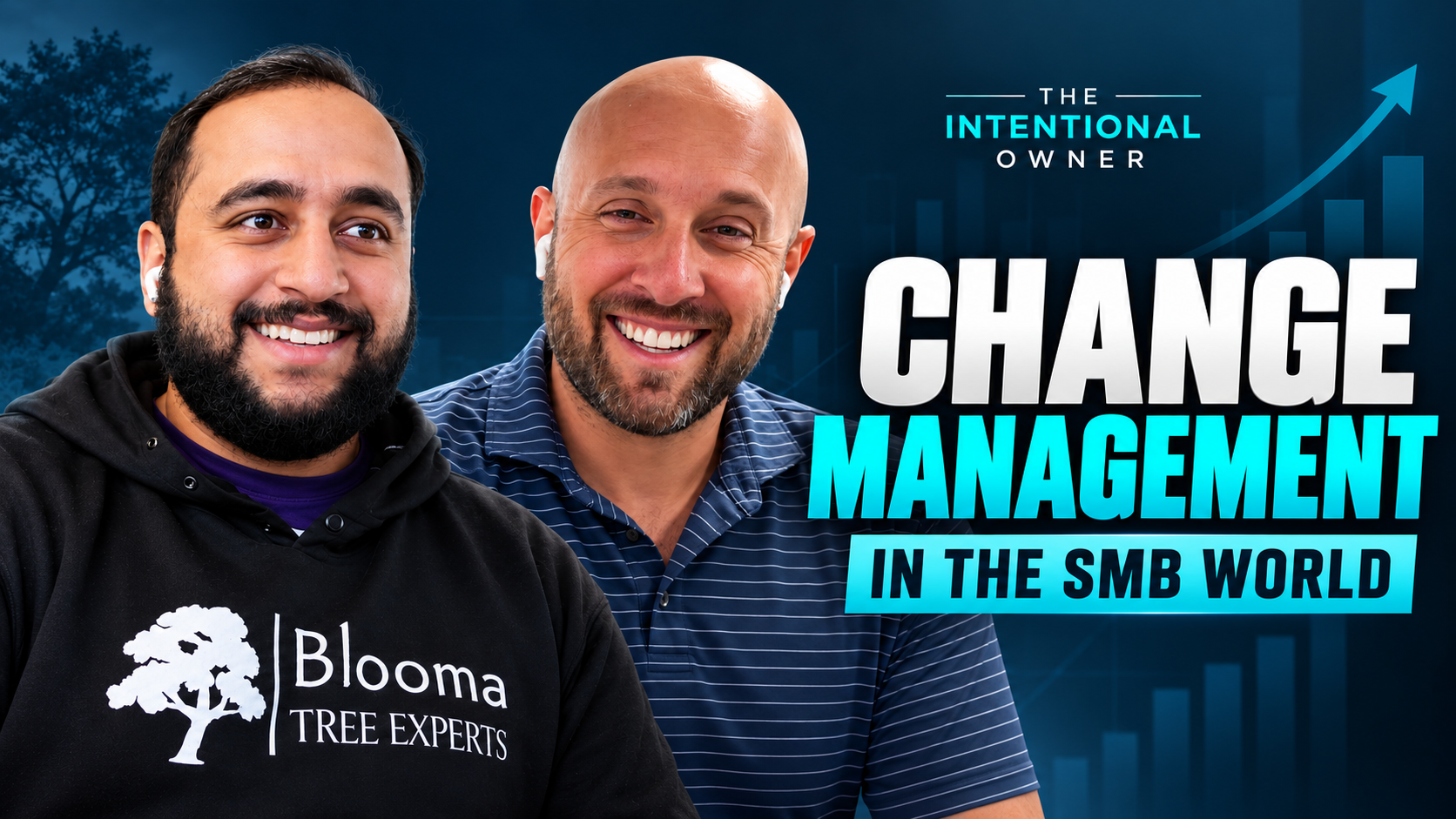
Kaustubh: All right. Welcome back to The Intentional Owner. We are wearing the same clothes, we're in the same place, 'cause we're recording a double today. How you doing, Sam?
Sam: And we're doing a double because small business ownership and life got in the way, and I had to kick a week, which is part of the deal. Figure it out.
Kaustubh: True that. Hey, at least when I come to Florida, we can do one recording in person, which we've never done. It's kind of sick.
Sam: We could do it l- we could do it live. Like do one- Yeah ... of those Zoom webinar ones where people can like jump in and ask questions.
Kaustubh: Oh, that's fun. Or we just take mics with us on the golf course, and then we just give Johnny the like five hours of us talking and chit-chatting, and he can figure out how to turn that into an episode.
Sam: No, we can't, 'cause you swear like a sailor when you're golfing, and that's not allowed. This is not an explicit podcast. Anyway, we're gonna get into a different topic today, and here's how I'll intro it. So I think you and I are lucky and fortunate to have the benefit of a lot of pattern recognition now amongst first-time business owners, seeing how first-time business owners handle the process starting on day one. And what is universally true is starting like day closing minus 10, it's super chaotic. And that chaotic phase doesn't really end for at least a few months, if not a year. The chaos- Yeah ... level stays elevated for maybe a couple years. For a long time. It just sort of changes subject. And what I've noticed fundamentally is not many entrepreneurs have a clear, like a business operating system that really all it does... And I'm gonna introduce like one of the tools, one that we use, and, and then I'm gonna try and like tweak it to represent maybe like a more approachable version for first-time owners, is- I don't think I've ever seen an owner before having bought for, for the first time lay out what their long-term objectives are in writing, both qualitative and quantitative. Here are my objectives for the next 10 years. And then at least for the tool we use, EOS, put it on the screen there, is- to say, given those long-term macro objectives of my business ownership, I wanna now dial v- that back to goals and activities that are in a more approachable time horizon, three years, one year- Mm-hmm quarterly, weekly. And so, i- like in a really simple way, it's like saying, "Here are the steps Along the way that have to be achieved in order to get to my long-term horizon. And for whatever reason, none of us think to do that.
Kaustubh: Mm-hmm. Yeah. And- Like, it's like the thought process of, like, a 10-year goal is actually just 40 quarters.
Sam: Right. Or, uh, and I think a lot of it is it's just a framework, right? So we use EOS, or I think it's called Entrepreneurial Operating System. Yep. It's laid out in a book by, written by Gino Wickman called Traction. It's a really easy read. It'll take you a day. But what, at least what I have found missing in so many of these first-time business owner, and I, I did too, is you're just, you're operating rudderless. Mm-hmm. And so you're operating from chaotic emergency to chaotic emergency. You're not taking the time to step back. You... The big one for me, and I think ultimately why I don't enjoy operating, is because I, unlike you, tend to be, like, the chaos creator. I respond to chaos. I have a hard time prioritizing of the 50 things on my small business owner to-do list, what are the four that matter? And this is, like, one big, clear prioritization schedule, is what it is.
Kaustubh: No, I like that. And when do you think, like, to your point, right, like when a, when you buy a business for the first time, T minus 10 days to T plus 90 to 180 to 365 days are chaos. It's just transition, blah, blah, blah. Like, when do you think it starts to make sense for a small business owner to actually attempt to articulate a 10-year vision?
Sam: That's a great question. Okay, so maybe just so I can introduce the tool a little bit more. Yeah. The first page of it is called the vision page, and it's all about essentially your, your core values, your core focus, your BHAG, or y- which- what is your 10-year target. And, and then there's, like, a three-year picture in there which is more financial oriented. I would say I actually think there's value in doing this pre-closing because you might not be able to lay out your 10-year vision for the business, but you can lay it out for your business ownership, for like your philosophy of owning. And I think if you can focus also on like just some near term priorities in the transition, it can help keep you clear. But realistically, there's no chance in the first six months you know enough about your business to actually have a tangible 10-year target.
Kaustubh: Right. So that's where I'm like, yeah, like at some point... 'Cause like I don't think I really sat down and thought about mission, vision, values. I, I... Well, I know I didn't, until I was at the like two and a half year mark. That's really when we im- went about implementing that.
Sam: Did you know that you had failed to create that vision? I think I felt it. Like did you not do it for a reason, or did you stumble across the idea- Yeah ... that this is the way competent business owners run a business, is by some operating system?
Kaustubh: Yeah, I think the f- to your original point, like the first year was chaos, and it was just getting through it. I don't think it occurred to me to have vision, right? Like, it just wasn't a part of what I was doing. Second year was also hard, 'cause that's where we were really entering the J curve. Like, I found the second year to be the hardest year of operations, where, you know, cash was tight, interest rates were up, and we're just managing it as best as we could. And at the end of year two is when I... And when we did that first acquisition, like is where I started to feel the, the pa- like the downsides of not having a vision, right? Where I was like, "Oh, like I don't have a good way to express to the team why I do what I do or why I do what I do." And I, I, yeah, I was just a little too rudderless. I was personally too rudderless and the company was too rudderless. And so at that time I went out looking and then I was like, "Oh, I guess this is why people do mission, vision, values," and it actually was quite helpful. But no, I think like it took me two years. It wasn't like a choice that I wasn't doing it, it was more of a like it didn't occur to me that I should do that, frankly, which is just like a, it's a, it's a symptom of inexperience
Sam: Same. And now it's so obvious, which is one of those patterns that we can recognize now that this is just something- Yeah ... good owners do. It can be, it can be a different tool and be called a different name, but the concept is in place generally. And but it's a good point. Is it worth doing ahead of a buy? You know, there's like so many unknowns before you buy a company, it's like, what's the point?
Kaustubh: I know. It seems so theoretical at that stage.
Sam: I would actually say like in the first six months, your entire objective is to calm things down, have s- smoothness, predictability, revenue, and cash flow. Like the priorities are so much more basic and about survival- Totally than any sort of grand plan. So I, I think I lean your way. It's probably not worth it.
Kaustubh: Yeah. But if you're an owner who's listening and you are now past the worst of the transition, seller is more or less gone or entirely gone, hopefully, and transitioned out, and like you have now put together a few months without the seller, and things like are still probably feeling chaotic because you're under staffed, under resourced, everything, but you're not in the like blur of like changing bank account numbers and phone numbers and all of that, like that feels like a good time to start thinking about this seriously.
Sam: It does. Because again, under the assumption that we as owners wanna do a few things. We want to grow our business Profitably, and to do it less focused on our, the owner's time and energy- Mm-hmm ... well, then you have to create a vision and lay it out for the entire team to be able to execute and absorb and believe in, because it does help answer a lot of questions that come up every day, right?
Kaustubh: Yeah. I mean- 'Cause I mean, I think of it as, and we've talked about this before, but I think of it as it, it provides you this, like, fallback rubric for all decisions, if there's not an obvious rubric in front of you.
Sam: Yeah. So, like, maybe we'll use the terminology from EOS, but I'm sure you have the concept too. For a long time, I always wondered... I think I was a bit of a, like a, a, a smart butt too about core values. I would say- Yeah ... why do you need core values? Like, those are soft, and we all just push through those. Like, this- Yeah ... is a waste of time. So- it's literally the first thing on the vision page, the first of the two pages, first two pages of EOS. Like, wh- when I say core values, what comes to your mind?
Kaustubh: I think, like, kind of a, a, a word that is sort of a bit of a, kinda, like, it's like a catch-all.
Sam: Okay. So I used
Kaustubh: to think of- Like, I think of, like, you have, like, four words. Yeah. It's not how we did our values. I'm curious to hear how you guys did them.
Sam: Okay. So we, at the end of the day, we make all decisions. This is in a perfect world, right? You kinda make all decisions with the promotion or not of your core values in mind. So- let's talk about some basic things. Hiring and firing and promotion or not of people generally comes down to a few things, one of which is, like, do they get it? One, it have the capacity to do it, like, are, are they able to? But then- Yeah ... at the end of the day, like, do they live by the core values of the business or not? Because- Somebody could be an absolute all-star, like a crazy productive salesperson, but if they're like a cultural cancer and behave counter to your core values, at some point you're gonna be at a crossroads r- related to like the money they drive versus the cancer they're spreading.
Kaustubh: Absolutely. Yeah. We've... What we did instead of doing straight up core values is we did what we call like the Blooma mindset, and we think of it as more of like how do you show up to work every day? Which, I mean, very similar obviously in practice to core values, but I felt like it made it a little bit more tangible to our team of like, "Hey, like this isn't just sort of like theoretical values we want you to hold in your body, your brain, or whatever. Like these are actually ways we want you to act every day." And so like, and the, the, the two that like I like the most out, we have four, but the two I like... And so one of them is about safety and like I own our safety. One is about learning and about, you know, I strive to promote a culture of continued learning. But the two that I like the most are one is about emotions, which is I will let my emotions inform me but not control me. To me, that's like a very tangible like how, like, you know, especially in a blue collar trade, like that's a big part of our day-to-day is like things get frustrating, things are hazardous. Mm. Like people get, you know, heated. Yeah. Like to me that is a very tangible how we approach our day, and somebody who can't, you know, manage their emotions is not a good fit for us. And then the second one that I think is really crucial is for team, like I will make decisions with the intention to create an environment my team can succeed in, right? And that's really, again, it's actions, right? It's like if you're debating between two choices, you should be able to make the choice that is best for the team and not just the best short-term answer for you. Like to me that's like a, that's like a value put into action.
Sam: That's a great point. Another framing to think about it is you, Kaustubh, were not gonna be out in the field with every crew. So core values are sort of the law of the day-to-day. Your team can enforce them, right? And if your team comes to you and says, or a crew foreman says, "Hey, somebody's behavior was X or Y," this is a way to judge are they a, someone who will fit into this culture or not, and you kind of point- Right ... to the core values to do that.
Kaustubh: Yep. No, I, I totally agree. Wait, so let, let's go back to EOS though, right? So like for the- your company's, the vision, I think maybe one thing I'm curious to hear you talk about is like where do... Like, what are like BHAGs, right? Like, you know, the big goals that are not... Like, do you ever see them when they're not purely just like be a bigger company?
Sam: That's a good question. So before we get into that, let me also offer- Yeah ... a lot of people will say, "I wanna run pure EOS." Like, they'll read the book, and, uh, like they will have seen religion, and they will say- ... "I'm gonna run this full bore. I'm gonna do two-day offsite annuals, a day offsite quarterlies, weekly level 10s." Like very pure. And then- Mm-hmm ... they start running it and realize that is a heavy lift. It's a big time investment. And so then you he- you will hear as an owner, a lot of people saying, "I run like EOS lite or kind of my own version." And so what I'm gonna try and do is even though we, PSG, run what I'll call pure EOS, we really- Yeah follow it to a T throughout the org, I wanna offer, if you've read the book, but you kinda wanna scale it down to match the size and sophistication and, and bandwidth of your team, what can you do? I, I would say core values, I think is a non-starter. You have to have them and use them and- s- sort of that is the, the bones of your business. You asked about a 10-year target or a BHAG, big, hairy, audacious goal. What's funny is I actually didn't get in an argument, but I challenged our implementer last week- as to whether or not you need one. Do you have one?
Kaustubh: No. I just don't get it.
Sam: We did. And nobody used it. Right. If you'd have asked our leadership team walking in what it was, nobody could say what it was. And, and so I asked, I said like, "Why do we have one?" Because if you're not aligned around it, you're not using it in, in kind of the way you use core values, what's the point? One of the best ones I've ever seen is like, I think it was Pepsi's BHAG was beat Coke, or Coke's BHAG was just beat Pepsi. Right? So like I can get why some... That, that's really creative. Yeah. But there's no natural BHAG for us.
Kaustubh: I, yeah, and so like when we did mission and vision, like for... And so like right, like mission is why we exist. Vision is who we will become to accomplish our mission is how we framed it. And so vis- our vision, like who we will become, that's, I think our, the closest I have in my head to the BHAG. Our vision is to build an enduring tree care business by enduring... Uh, excuse me, by empowering our team to be best in class. And like that, I think of that as like a state of being, right? Like that's not like a end goal. That is like a sy- That like, like our business needs to exist in that like ex- like frame of existence. I don't, I don't know how to say it. And like that is what we're trying to do.
Sam: Okay. I think I like that better than like some smart, right, quantifiable, trackable- BHAG, which to me just doesn't seem to serve a purpose unless you kind of think and behave according to it every day, and we definitely- Right were not.
Kaustubh: And I mean, there's like, I think about it sometimes when I... 'Cause like obviously I get why people want a clear, like quantifiable financial goal in particular, right? Mm-hmm. Like, and, and a very common, I think, BHAG for a small trade business would be like we want to be, like, you know, if you're at 3 million of revenue, you might say, "Hey, in 10 years we wanna be 20 million of revenue, or 15," whatever. Pick a number, right? And, uh, like when I look ahead at our path, like I'm not particularly compelled by hitting a specific revenue target. I think I'm more interested in a larger EBITDA target for one, and I, I'm really focused on, on like how hard or easy does it feel to generate that EBITDA, right? Like, and so to me, like I... And so that's where like this vision, that component comes back of like if we have built an enduring tree care business with our team operating best in class, like that means that the EBITDA we are generating should feel pretty easy. Like, that's w- I think how I think about this is like, okay, like, and obviously like part of being enduring is we need to be big enough to have redundancies and we need to have a cleaner balance sheet than we have today. So like there is growth baked into like achieving that vision on a cash flow basis for sure. But it's like, it's not obvious to me that like at a certain point adding EBITDA is actually in line with the vision as opposed to like continuing to make that EBITDA even sturdier and even, you know, more anti-fragile and whatnot. Which like, yeah, I don't know. Like, I, that, that's where like the, the BHAG has never quite sat right with me.
Sam: That's a good point. Yeah, and what you don't wanna do is say, "Okay, we're short on EBITDA, so for three months we're gonna totally scrap our lead gen system- Yeah ... go cold call, and try to, like, manually override how we- Correct hit the EBITDA target.
Kaustubh: Exactly. Like, and, and I mean, to that point, right, like, for Q4 we have a goal. I've looked at the goal and what... And I translated to the team as like, "Hey, to hit this revenue goal and to hit this sales goal and to hit this EBITDA g- goal, like, this is what we have to do each week," right? And what we have to do each week is, fits within our system. Mm. If it doesn't fit within the system, like, I don't really get the point of that as a goal. Like, it just- Yeah ... doesn't make any sense to me.
Sam: Good point. Okay, next one is, there are some other areas of the vision sheet, like core focus, marketing strategy. The one that I think helps shiny object people like me, like a lot of entrepreneurs- Yeah ... is-
Kaustubh: Me as well, for sure.
Sam: For sure. Is there's some areas where you're supposed to just write out, and your team's supposed to contribute to what is your, what is the purpose of the business? What is- Mm-hmm ... the niche you operate in? And what is your target market? Like, who is your IDP, right? IDC- Yep ... sorry, ideal customer profile. ICP. The ICP.
Kaustubh: ICP.
Sam: ICP. So, because as a business owner, I don't care if you're five years in or five months, I think it's easy for entrepreneurs to try and chase opportunities everywhere. And to create that target market, you know, your ICP- and maybe most importantly, to like stay honest and accountable to not chasing other stuff. Right. It really helps to have it written down and to have identified, like who is your target market? So who, what is
Kaustubh: yours? That's interesting. Yeah, we haven't done that. But if I were to think out loud for a second, like I think our target market is tree owners, right? Like tree owners who value their trees.
Sam: Okay. Tree owners owned by tree homeowners? Or I'm trying to make the distinction between- No ... commercial and residential. Right. I'm also trying to make a distinction between where is your target market geographically?
Kaustubh: Hmm. Right. Okay. Yeah, so then like to me, I don't actually... I'm fine with us doing residential, commercial and municipal work as long as it is for clients that value their trees. Because if they don't value their trees, they're not gonna work with us 'cause we're too expensive.
Sam: Love that. Yeah. We talk about it in terms of like we have this qualifier relationship driven general contractors- Nice because the transactional general contractor who's looking for lowest bid- Yeah ... not our target market. We want the one- Right ... focused on relationship predictability, quality, professionalism.
Kaustubh: Totally. No, that, that's right. So that's sort... Like I, and I think of that as like people who actually like value their trees or like their trees, they're the... Like but it's simpler, right? Like, they're looking to partner with an arborist. What about- As opposed to like hire the cheapest, cheapest like tree cutter
Sam: What about geography for you?
Kaustubh: For geography, it's basically like, I mean, we have our geographic map, right? And so I have a pretty clear idea of what our service area is. We've been, like, playing with the edges of it based on, like, how busy we are. But, but no, like our, our geographic area is pretty clear. It's basically like all of Seattle, north through Lynnwood, northeast through Woodinville, east through Redmond, south through Seattle, Bellevue, Mercer Island, and we don't go south of Seattle.
Sam: Got it. So it's, let's call it cleaner for you, single location. May become a little hairier when you're two locations.
Kaustubh: Yep. But I would say it's basically, like, within a 45-minute drive of our yard.
Sam: Okay. So we had this big problem because we, when we were implementing EOS had [figure omitted] locations around the country with humongous gaps in between them. And so how do you identify, like, your geographic market? And the way we did it was to say that we pursue new customers within those existing markets we have a location, but also outside them selectively to, on jobs that can be done profitably from afar. And that was sort of our proxy for how do we choose when to do a job outside of a core market where we have a location, is to make sure we can only do it if we do it profitably.
Kaustubh: Right, which you'd think would be a given, and yet it's not really.
Sam: No, because think about it. It's like if you're intent on serving a general contractor and your entire strategy is to follow them so your CAC is lower, well, then where does the limitation on how you'll follow them, you know, play through? Right. And essentially when you can no longer keep your gross margin profile up, you have to say no.
Kaustubh: So that makes sense. Yep. I, so I get how you've clarified your service area. So you have your ICP, your service area. What else is on there?
Sam: So there's a lot of other stuff on there, but I, a- and we'll go through it, right? So core values, your core focus. So things like what is the, the reason your business exists? For us, right, protecting people and property, kinda obvious. You know, other things like our particular niche. There's a BHAG, there's your target market, there's the three things they'll call, they'll, they are called the three uniques that make your business particularly unique in what it does. Mm. My whole point is pure EOS, yeah, it's great to have all of that, be very clear. But for somebody who's six months in and they're just starting out and they want a system to follow, do you need that stuff? I don't think so. I think you can get away- Right ... with core values, maybe a, a, a purpose, and your target market, and call it a day. Yeah. Just some baseline, kinda just like what direction are we headed. Correct.
Kaustubh: What do you think about from the EOS in terms of the, like the weekly L10s to the, like quarterly rocks, to all of that. Like, what parts of those do you think are important for a new, relatively small business owner to implement?
Sam: So this is where I'll go the, I'll take the opposite tact, which is, whereas I said I think you can run really light on the, on the sort of soft stuff on your vision sheet- I think it actually makes a lot of sense to stay pretty pure on the cadence. I think it really helps, if at all possible, to do week, we'll call it like a weekly meeting, EOS would call it a level 10, where you are essentially going through your scorecard of KPIs for the week, and going through the issues for the week, and through your quarterly, we'll call it rocks, but it's just quarterly goals. Mm-hmm. And just having a weekly one-hour check-in where you quickly lay out how did you perform the week before, what issues are on your plate to address, and, you know, relative to your longer term quarterly objectives, are you on track or not?
Kaustubh: Yep. Basically just that. And, but I guess, like, if you, if you're the owner of a small business that you bought, like 12, 18 months ago, like who's in that meeting?
Sam: I think it's maybe you and... And this is a great question. You may end up having to- massage it with somebody that's like an accountability partner. You
Kaustubh: know? Almost- Because my gut is, I think, at least if I look back at myself two years ago, like, and I actually attempted for a little bit, now that I think back, I attempted doing this L10 concept with my crew leaders and our sales team. Just didn't quite make sense/work. It's just, like, not what their work is designed for or designed like. And so my gut is it's a little bit more early on of, like, this is almost like a solo project that you undertake yourself.
Sam: It could be. If you don't have a general manager, then- Yeah ... you could be alone in it, and that's fine. Because I think what it really does is for somebody who ha- doesn't have the time, they think, to step back, to think on the business- Yeah ... to think how are we performing relative to our stated objectives, this creates... This is your outlet for accountability there. And- maybe this speaks more to me than it does to you, because I've always been more of a uh, shiny object entrepreneur type that has a hard time- Yeah like having a framework, this really made a lot of sense to me because it helped me step back from the day-to-day. Right.
Kaustubh: Yeah, and I mean, like, I think about two years in, I started much more aggressively, like every Monday morning, I, I, I decided which are the one to three priorities for the week, right? The, like, on the business stuff. Um, and you kind of, like, pre-make that decision before the week's, like, firefighting begins. And so in many ways, like, that is like an L10 just by yourself, and that as you actually have a real team around you that, like a real leadership team, you can start to turn it into an actual meeting.
Sam: Agree. Okay, so the question I was gonna ask you is, EOS has an answer for how far in the future is the farthest you can plan from, like, a financial objective and KPI tracking perspective. Like, if I were to ask you how far in the future are you willing to predict revenue, EBITDA, and backlog- how far out are you?
Kaustubh: I think I, I would feel comfortable building a 12 months out forecast.
Sam: Okay. Forecast, meaning something you think is, like, truly achievable and you are on track to getting there. A- akin to a budget?
Kaustubh: Yeah, akin to a budget. Exactly.
Sam: Got it. So EOS would tell you to do this on a three-year time horizon. So it's challenging, right? Because you can kind of see a path to where you are, you know, October of 2027. To think about where we would be October of 2029 is, like, a fundamentally different exercise. And to me, this is the one I love the most because it feels aspirational. Right. And it somewhat lays out, like, an idea of what the business will look like potentially when our, like, private equity sponsor chooses to, you know, sell the business. So it gives us, like a- Yeah ... totally different framing. What do we wanna be some three-year distant time in the future? And it might look a lot different than what it looks like today.
Kaustubh: No, it's an interesting thought where, like, I have done, like, two to three years out, like what do I want the business P&L to look like, but I don't view that as, like, a forecast. I view that more as, like, a goal.
Sam: Yeah. And I think that's the difference, right? Like, a one-year- What do they call a year so I use the terminology right? A one-year plan is- Right ... it's meant to be something you, you define and hit, akin to a budget. And a three-year picture- Right ... is much more aspirational, and to get you thinking outside the box is the best way to put it, right?
Kaustubh: No, I, uh, that's right. And I mean, like, when I look back, I think it was It, when was this? It must've been December 2024 when I did our t- annual team meeting. I put on there that my hope was, or my goal was by December 2026 that we would be a five crew company. And so I... And, and what all that entails. And like, you know, like, if we close this deal, like, we will be actually, believe it or not, which is kind of crazy. Uh, if we don't close the deal, we'll be a four crew company, and I'm kind of okay with that. But, you know, like, that was a helpful... Like, but putting a goal of five... Like, actually you know what it really helps with is like by having the goal that everyone knew that we're trying to build to a five crew company when we were at three crews, it means like, hey, like, when we're thinking about what systems to build or what projects to undertake, we are on purpose building them for an eventual five crews. That's actually, I think, the most impactful part of that, was like we looked at when we were implementing new systems like, "Hey, will this hold up at 60% more volume?"
Sam: I think that's right.
Kaustubh: And that's the part that I think, like, where people go sideways when they don't have the goal is they're like, "How do I solve my problem?" Which is like, our systems don't work that well, and they solve their problem, and they build a slightly- Mm-hmm ... better system, as opposed to what is the problem... Like, what... how does this system need to hold up, like, in two years?
Sam: Exactly. So... And what's interesting about just, again, the tool, whether you run true EOS or just a light version, is it got everybody rowing in the same direction to a goal that was kind of not foreseeable in the near term. We have a interesting and different problem, which is we grew super fast the first three years. Largely, l- a large amount of the chaos came from M&A. Right. And so now we've had to go through, like, a digestion period where we kind of build out the backbone of the business- Yep ... to be truly integrated. Yep. All the while doing more and more M&A, some of which has been, like, transformational in size. And so you can imagine our... Like, the list of things that need to happen Between now and three years from now is so long. Like, but having to be disciplined to say, "We are not gonna do all of them." We literally took the time to put 30 things on the board. Yeah. But then we can choose three to seven. Yeah. It's been a really helpful prioritization tool for us in a world where there's so much c- chaos, so much going on, [figure omitted] people in the org, [figure omitted] physical locations. Like, in all of this chaos, what are the three to seven things that must be true?
Kaustubh: Yeah. Well, it's funny 'cause I think I... This might be a Warren Buffett-ism I, I feel like I saw, but like this idea of like, yeah, like if you list out the 25 things, you know, that you personally or in your business like w- want to work on, and then you pick the three most important ones, the actual like im- key takeaway from that is the other 22 are things you are not allowed to do, right? Like- And part ... like what he... Yeah, like what he w- I, I am pretty sure it's Warren Buffett, but I might be misatt- attributing. But it's like, it's not actually... The hard part isn't prioritizing between good choices and bad choices. It's actually prioritizing between good choices and also good choices, right? Yeah. Like, that's actually the challenge. That's the hard part, is deciding which of all of our good choices we're gonna focus on, and then actively avoiding the other good choices.
Sam: Yeah. The, the, the special nos are the ones that hurt.
Kaustubh: Yeah. No, exactly. Yeah, so-
Sam: Okay, so then- ... it uh, just so we don't like go blow everybody's time budget today, I think the- maybe the most transformational part of this is the framework of EOS, or whatever version you implement, what it does a nice job of is it says, okay, so for the first time you laid out a big picture of what the business looks like in three years, you know, financially, revenue, EBITDA, pipeline, backlog, whatever your measureables are- Right and a list of things about the business that are true. Whether it's like integrated ERP or, you know, uh- Something about your team. Doesn't matter. Yeah. But what I really loved is then it, it gives you a framework on the second page, of second of two pages, to boil it down into what feels like bite size pieces. Mm-hmm. Midterm objectives to get to that three-year target. Yep. So it then says, okay, if that's true about what the business looks like in three years, well, what will it look like at the end of next year, 12 years out? Revenue, EBITDA, gross margin percentage, backlog, whatever. Yep. So if, if the three year is true, what will be the case in one year to keep you on the path to three? And this is where things start to feel manageable. Like, is it manageable to, to put [figure omitted] locations on a single ERP when none of them are? Probably not. Sure. Can we do half of them in 12 months? Yes.
Kaustubh: it's sort of selecting an ERP that allows for 50 locations in the future.
Sam: Okay. Then further they'll say break that one year, so now we have a- Foreseeable target in 12 months, what does quarter one look like? Right. If quarter one keeps us on path to full year targets. Right. And then we kind of operate in a quarterly world now, where we come together every week to report on and take stock of how we're doing every week- Mm-hmm towards quarterly goals. Mm-hmm. And that's the cadence. Every Wednesday we meet, we spend an hour and change, and we go through our scorecard, our quarterly rocks, goals- Mm ... and issues related to hitting them. And then every quarter we go do an offsite and we reassess them. What does quarter two look like in the context of hitting the full year goals? Right. And then we just continue to iterate, and it gives you like a framework and a cadence for that- Mm-hmm ... accountability year-round. And I really like that.
Kaustubh: No, that, that makes sense to me. I think what I wanna do next year is take that, but then adjust it a little bit for the seasonality of our business, and do it in a way that makes a little bit more sense to me, where I think what I wanna do is I want the month of January to be our, like, assessment month, right? This is, like, where we assess how last year went, we do our basically, like, issues list for the year effectively, and we set our plan for the year. Which, like... And then we have one really good period of time to build in the business, which is February, March, April, May, right? So it's like a four-month period there. And then basically have a period of just, we are just out there doing execution, which is July, August, September. And then we've... Or, and really it's July, September, Octob- or sorry, June, July, August, September Arguably October. So like maybe it's like, that's like a five-month period, and then you've got one little two-month period, November, December, to really just like finish out the year. I don't know. It feels like there's something a little bit different than the quarterly cadence. And, and like maybe then if we have this, like it would be a two-month, you know, two-month, two-month. Like Feb, March, one set of projects. April, May, a second set of projects, and like we do it that way instead. I don't know. I'm just thinking like it's not like these projects that we decide on are actually perfectly scoped for one quarter anyways, right? No. We just, we just choose that cadence.
Sam: Right. And I think that's the beauty of any system isn't that it's perfect, but that it works for, for the business you run. Correct. And you're true to it. It almost feels like a workout program. Like a workout program is a dime a dozen. It's the accountability and consistency to it that creates the value.
Kaustubh: Yeah. And that's a good... I think that's a really nice kind of putting a bow on this conversation is whether or not you use EOS pure, EOS light, or just something completely different, you need some sort of a framework as a business owner to set long-term goals that break down into medium-term goals, that break down into short-term goals. Like that function, that, that, that whatever structure, you need that.
Sam: In order not to be rudderless- in a, in a game you've never played before, because most of us haven't. Exactly. It's mid-late October. If you're hearing this, then you probably know that Kaustubh and I are going to host a happy hour in Tampa, Florida on Tuesday, November 10th. Do we know where yet? No. Do we know what time? No. But we do know- Evening ... that we, it will be in the evening in Tampa, Florida, and it will include some beverages and a good time amongst the ETA community, broadly defined.
Kaustubh: Oh, yeah. I'm
Sam: pumped. So stand by for details. We'll share 'em. Thanks for listening, I guess.
Kaustubh: Hopefully by the time this airs, the details will be shared, but we don't have the details yet at time of recording.
Sam: This is like mind-bending.
Kaustubh: It can't work. This is Inception. Yeah, exactly.